

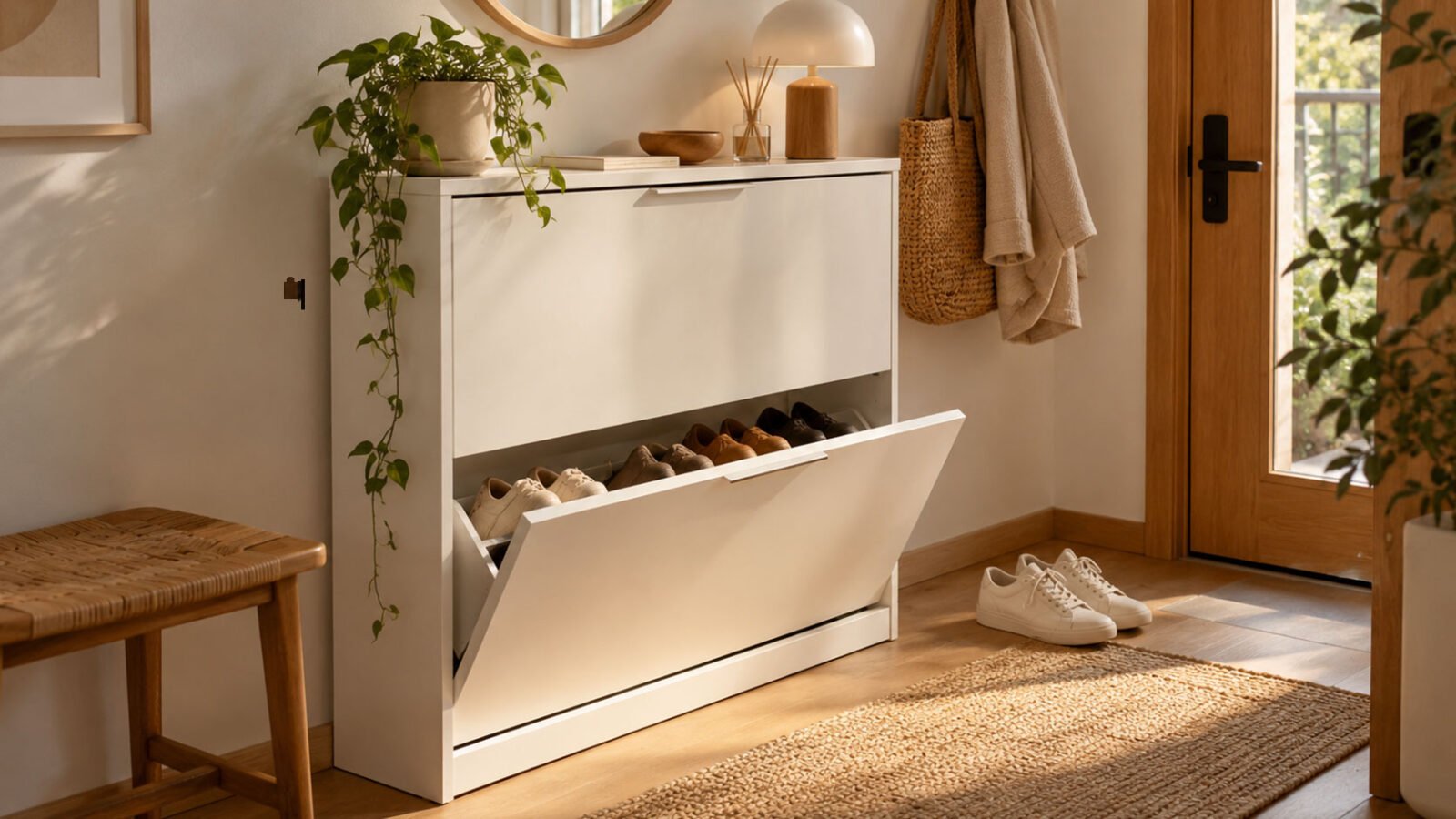

A small entryway can become cluttered surprisingly quickly. A few pairs of everyday shoes by the door can take over the walking path, while a regular shoe cabinet may be too deep for a narrow hallway.
A narrow shoe cabinet helps use vertical space and keep footwear out of sight without taking up as much floor depth as a conventional cabinet. But the slimmest option isn’t automatically the best one. A cabinet needs to fit your hallway, open without blocking the door, and hold the shoes you actually wear.
For this guide, we compared five slim shoe-storage options using published dimensions, product descriptions, available marketplace data, and customer feedback. We have not physically tested these products, so the recommendations are based on available specifications rather than hands-on testing. Prices, ratings, review counts, and availability can change; check the live listing before ordering.
Quick picks: narrow shoe storage at a glance
| Product | Published depth | Best fit | Important trade-off |
|---|---|---|---|
| HOPUBUY 3-Drawer Slim Shoe Cabinet | 6.69 in | Very tight spaces | Limited interior depth can restrict larger shoes |
| VEVOR 2-Drawer Rattan Shoe Cabinet | 6.61 in | Slim storage with a natural texture | Smaller cabinet; confirm usable pair capacity |
| SoBuy FSR78-W 2-Drawer Shoe Cabinet | 9.4 in | Narrower cabinet width | Customer feedback suggests larger shoes may be a tight fit |
| QIVOMIX 2-Drawer Shoe Cabinet | 9.4 in | A wider two-drawer cabinet | Requires more width and assembly space |
| BORNOON 3-Drawer Shoe Cabinet | 9.45 in | More concealed vertical storage | Taller and heavier; anchor it as directed |
Measurements are manufacturer or retailer-reported exterior dimensions where available. Cabinet depth alone does not guarantee that all footwear will fit. Check the internal drawer measurements, and allow clearance for the drawers to open.
1. HOPUBUY 3-Drawer Slim Shoe Cabinet — Best for the Tightest Gaps

Published dimensions: approximately 6.69 in deep × 23.22 in wide × 41.38 in high.
Affiliate Disclosure: As an Amazon Associate, I earn from qualifying purchases. This means I may earn a commission if you purchase through links in this article, at no extra cost to you.
When every inch of hallway space matters, a cabinet around 6.7 inches deep is worth considering. This HOPUBUY model uses three flip-down drawers rather than traditional doors that swing outward into the room. Its narrow profile may suit an apartment entryway or a small space beside a coat closet.
Why it stands out: The shallow footprint and vertical layout are its main advantages. The tilt-out style also keeps shoes concealed, creating a calmer look than an open rack.
What to check first: Very slim compartments can be restrictive for larger sneakers, broad shoes, or boots. Published dimensions for the outside cabinet are not the same as the usable interior depth. Customer feedback associated with this style also includes concerns about assembly and stability, so follow the supplied instructions and install the anti-tip hardware as directed.
Best for: A narrow entryway where a deeper cabinet would interfere with the walking path, provided your everyday shoes fit the compartments.
2. VEVOR 2-Drawer Rattan Shoe Cabinet — Best for a Natural, Textured Look

Published dimensions: 6.61 in deep × 23.62 in wide × 34.53 in high.
Affiliate Disclosure: As an Amazon Associate, I earn from qualifying purchases. This means I may earn a commission if you purchase through links in this article, at no extra cost to you.
This compact model combines a very shallow footprint with rattan-style drawer fronts, wood-look details, and a shorter overall height. The woven texture can work particularly well with warm minimal, Scandinavian, or natural-material entryway decor.
Why it stands out: It is one of the shallowest closed-storage options in this comparison, but it looks more decorative than a basic fabric rack. At about 34.5 inches tall, it may also be easier to position beneath a mirror or wall art than a taller cabinet.
What to check first: The trade-off for a shallow, short cabinet is capacity. Confirm how many pairs fit in the exact version you’re buying, especially if you wear larger sneakers or want to store boots. Marketplace prices for this model vary by retailer and listing; use the Amazon listing for the current price and variant details.
Best for: Someone who needs a small footprint and prefers a natural, textured look over a plain white cabinet.
3. SoBuy FSR78-W 2-Drawer Shoe Cabinet — Best for a Narrower Wall Section
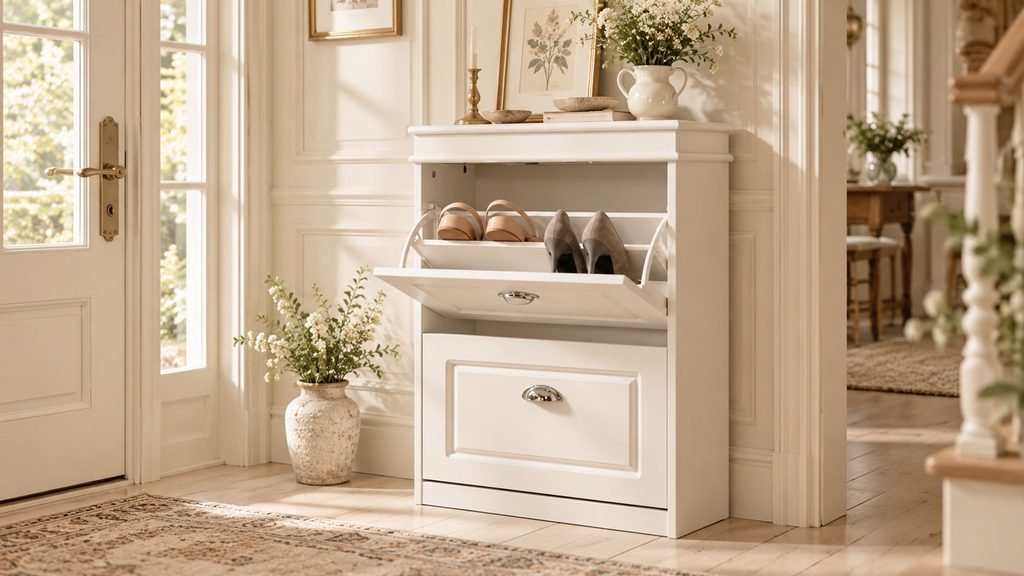
Published dimensions: approximately 9.4 in deep × 21.3 in wide × 32.7 in high.
Affiliate Disclosure: As an Amazon Associate, I earn from qualifying purchases. This means I may earn a commission if you purchase through links in this article, at no extra cost to you.
Depth is not the only measurement that matters. If the available wall section is narrow, a cabinet around 21 inches wide may be easier to fit than a wider model with more drawers.
This SoBuy cabinet uses two flip-down drawers with divided compartments and a small top surface for keys or a catchall tray. Its overall height is relatively low compared with the taller three-drawer cabinets in this list.
Why it stands out: The narrower width and lower profile give it more flexibility in small foyers, beside a door frame, or along a short hallway wall.
What to check first: Available customer feedback is mixed on assembly and durability, and some reviewers say larger shoes don’t fit comfortably. Treat advertised capacity as an estimate, then compare the inside compartment measurements with your own footwear. This is a better candidate for a smaller everyday rotation than for a household trying to store a large shoe collection.
Best for: A small wall section and a modest number of everyday shoes.
4. QIVOMIX 2-Drawer Shoe Cabinet — Best Mid-Height Option

Published dimensions: approximately 9.4 in deep × 31.5 in wide × 38 in high.
Affiliate Disclosure: As an Amazon Associate, I earn from qualifying purchases. This means I may earn a commission if you purchase through links in this article, at no extra cost to you.
The QIVOMIX option has a similar shallow depth to several flip-drawer cabinets, but its wider body offers more front-facing storage. The walnut finish is suited to an entryway where the cabinet will be visible rather than hidden inside a closet.
Why it stands out: A mid-height cabinet can provide concealed storage without rising as high as a three-drawer tower. Published product information describes adjustable internal dividers and an anti-tip device, which are useful features to check when comparing models.
What to check first: Its 31.5-inch width needs to be measured carefully against the usable wall, baseboards, nearby doors, and any trim. A unit that is under 10 inches deep can still block a walkway if it is too wide for the space or if the flip drawers need more clearance than you have.
Best for: A household that wants closed shoe storage in a wider but still narrow-depth cabinet.
5. BORNOON 3-Drawer Shoe Cabinet — Best for More Vertical Storage

Published dimensions: approximately 9.45 in deep × 31.5 in wide × 47.2 in high.
Affiliate Disclosure: As an Amazon Associate, I earn from qualifying purchases. This means I may earn a commission if you purchase through links in this article, at no extra cost to you.
The BORNOON cabinet adds a third flip drawer and more vertical storage while keeping its published depth under 10 inches. It is one of the higher-priced options in this list, so it makes the most sense when you need the added storage and have enough height available.
Why it stands out: The additional drawer gives you more zones for separating daily shoes, seasonal footwear, or different family members’ pairs. Its high customer rating and large review history in third-party Amazon tracking snapshots make it worth comparing, though ratings are not a substitute for checking recent written reviews.
What to check first: This is a tall, heavy piece of furniture. Verify the current listing’s weight, assembly requirements, clearances, and anti-tip instructions before buying. The advertised pair capacity can vary depending on shoe size, shape, and how the compartments are arranged.
Best for: A household that needs more concealed storage and has a suitable wall section for a taller cabinet.
Affiliate disclosure: Little Things at Home may earn a commission from qualifying purchases made through links in this article, at no additional cost to you. As an Amazon Associate, we earn from qualifying purchases.
How to choose a narrow shoe cabinet that actually fits
1. Measure depth, width, and height
Measure the available space at floor level, including baseboards or trim that push furniture away from the wall. Then check the cabinet’s full exterior width and height. If the cabinet sits behind a door, open the door fully and confirm it won’t hit the cabinet.
For a tight hallway, leave enough walking clearance after the cabinet is in place. A product described as “slim” can still make the space uncomfortable if it projects too far from the wall.
2. Measure the opening and the shoes
Flip-drawer cabinets save floor space compared with regular hinged doors, but each compartment still has limits. Larger men’s shoes, chunky sneakers, high-tops, and ankle boots may need more depth or height than the product photos suggest. Look for internal compartment dimensions when the seller provides them, and read recent reviews mentioning shoe size and fit.
3. Don’t compare capacity numbers blindly
“Stores 18 pairs” is not a universal measurement. Shoe sizes and styles vary, and some product capacities assume smaller shoes arranged at specific angles. For families with bulky shoes, an open rack or a deeper cabinet may be more practical than the slimmest flip-drawer option.
4. Check stability and anti-tip hardware
Tall, narrow furniture can tip when drawers are pulled open, especially if the cabinet is not loaded evenly. Follow the manufacturer’s assembly and wall-anchoring instructions. If you rent, check your lease and ask your landlord before drilling; a freestanding label does not always mean a tall cabinet is safe without anchoring.
5. Choose between hidden storage and quick access
Closed flip drawers create a tidy look and help conceal footwear. Open racks are easier for shoes that are worn every day, and can work better for taller boots or irregular shapes. If you need only a few pairs by the door, a narrow closed cabinet may be ideal. If you are storing a family’s entire shoe collection, consider a taller rack or closet organizer instead.
6. Check shipping, returns, and assembly details
Entryway cabinets can be heavy and may arrive in flat-packed boxes. Before ordering, review the delivery details, return policy, included hardware, assembly instructions, and any reported problems with damaged panels or missing parts. Make sure you have the space and help needed to assemble the unit safely.
Which narrow shoe cabinet should you choose?
- For the tightest footprint: Start by comparing the HOPUBUY and VEVOR options, both published at roughly 6.6–6.7 inches deep. Confirm usable compartment dimensions first.
- For a narrow wall section: The SoBuy model is less wide than several of the larger cabinets.
- For mid-height storage: The QIVOMIX option offers a wider, two-drawer design.
- For more vertical storage: Compare the taller BORNOON cabinet, while paying close attention to height, weight, and anti-tip installation.
There is no single best shoe cabinet for every small entryway. The best choice is the one that fits the actual wall and walking clearance, accepts the shoes you own, and can be installed safely.
Frequently asked questions
How deep should a narrow shoe cabinet be?
The products in this guide range from about 6.6 to 9.45 inches deep. A shallower cabinet can preserve more walkway space, but internal shoe compartments will also be more restrictive. Measure your hallway and your largest pair of shoes before choosing.
Do narrow shoe cabinets fit men’s sneakers?
Some do, but not all. A shallow flip-drawer model may require shoes to be angled or may not close around larger sizes. Check the internal compartment dimensions and customer feedback for your shoe size instead of relying only on advertised capacity.
Are flip-drawer shoe cabinets better for small entryways?
They can be, because the drawers tilt outward instead of requiring a full hinged door swing. However, they still need room in front to open, and the compartments may be more restrictive than open shelves.
Do tall slim shoe cabinets need to be attached to the wall?
Follow the specific manufacturer’s safety instructions. Many tall or narrow storage cabinets include anti-tip hardware for a reason. A cabinet being labeled freestanding does not automatically mean it should be used without anchoring.
Is a shoe cabinet better than an open shoe rack?
A closed cabinet hides visual clutter and keeps shoes less exposed to dust. An open rack is usually easier to access, may fit taller shoes better, and can be simpler to assemble. The right choice depends on available depth, shoe type, and how often you rotate footwear.
Keep your entryway organized
A narrow shoe cabinet can make a small entryway feel calmer, but the fit check matters more than the product’s marketing name. Measure the wall and door clearance first, compare the interior space with your footwear, and choose storage that suits your actual daily routine.
For more small-space inspiration, explore our guides to small living room ideas and small bedroom ideas.